
Landscaping and Patios

In today’s post, we wanted to educate you on what you need to know about your landscaping and patios. This information will make you a more informed homeowner and hopefully prevent any costly mistakes!

First thing to note: The grade of your lot has been established to drain water away from your home.

The soil around each home site is graded to create swales that channel storm water away from the home.

NOTE: Please consider that any changes you make in the grading and drainage of your lot. Failure to maintain the established grade and swales may result in damage to your home, your lot, and your neighboring property. Damages to your property and to neighboring property will be your responsibility.

Do not change the swales on your property. These swales are the graded areas designed to comply with local codes and engineering requirements by directing the flow of water away from your house. Alteration of the swales can result in serious damage to your foundation. Fill material next to the foundation that may have settled needs to be replaced and the original grade re-established to prevent ponding of water against the fence or home. It is the homeowner’s responsibility to maintain the original grading of your lot and preserve good drainage.

NOTE: Any alteration of the established grade net to your home that has been treated for termites may void the termite warranty.

Landscaping

Landscaping can change the grading of your lot. We suggest that you consult your professional landscape contractor when the time comes to landscape your lot.

Do not plant along your homes foundation of fence wall. Direct all irrigation away from your foundation, patio, porch, fence and sidewalks. Keep all plants a minimum of two to three feet from the foundation and fence wall. Irrigating at or near the foundation or fence wall will increase the likelihood of soil expansion or settlement resulting in cracked concrete or movement in the home or fence.

To prevent erosion and ponding of water:

  • Do not alter the soil grade.
  • Keep swales open and free of leaves and debris. Do not build sheds, sidewalks, hot tubs, decks, fences, pools, or gardens in the swales. Otherwise water may not flow properly through the swale.
  • Direct water runoff away from the home. Do not allow sprinklers to form puddles near or against the foundation.

Flowerbeds can significantly change drainage patterns. We suggest that you consult a professional landscape contractor before you dig flowerbeds. In any case, keep plantings in flowerbeds a minimum of two to three feet from the foundation. This will prevent excessive water from collecting at the base of the foundation.

Provide ample growth between plants and your home. The ground next to your home should always slope away to prevent standing water. If water is allowed to stand or pool next to your home, damage to the foundation and the home will result. The water could also seep into your home and damage the interior and furnishings.

Furthermore, other additions and changes can alter the drainage of your lot and cause water damage. These changes include sidewalks, patios, spas, pools, fences, walls, and planters and play structures. Before you make any additions or changes to your lot or the structures on your lot, give careful consideration to the effect the changes will have on drainage. If you have any questions, consult a professional before you begin the project.

If you have gutters and downspouts on your home, this gutter system is to help in keeping water away from the foundation of your home. The downspouts drain onto slabs or concrete diverters. The diverters are some times designed to channel the water into a swale. If the swale designed to channel the water from these downspouts is altered, be sure to provide proper drainage. It is your responsibility to keep all gutter and downspouts clear of debris.

Patios
Patios and other structures that you add to your home after your orientation will not be covered in your Limited Warranty. You must check with your homeowners association and local municipality before you begin any addition to your home.

Posted in Uncategorized

Air Conditioning, Heating and Ventilation

The comfort that is provided by our air conditioning, heating and ventilation systems is very important. Sometimes we take this for granted until we are without these systems. Please continue reading for important and helpful information regarding these systems.

Air Conditioning:

The air conditioning and furnace unit is usually located in the attic or a mechanical room. The supply registers located in each room are adjustable. The filter for the air conditioning unit is located in the return air grill which is typically found in a central hall way or the mechanical room. This filter should be changed monthly. The thermostat is typically installed in the same hall as the return air grill.

Your home is equipped with a high-quality heating and air condition system that complies with local and state energy codes. With proper care, the systems will provide many years of enjoyable, dependable service. You should read the instructions and become familiar with the heating and air conditioning systems before you use them.

The air conditioning and furnace unit is designed to maintain a comfortable temperature within the home. The unit works best when set at a desirable temperature and left alone. Once the home and all of the contents within it have reached the desired temperature, the system will cycle on and off to maintain this temperature. This is more efficient and cost effective than shutting off the unit which would require extensive heating or cooling to achieve the desired temperature. This will also help to prevent wood and drywall from being damaged due to excessive heat or cold, especially if your home is left unoccupied for an extensive amount of time.

Refrigerant passes through the coils in the condenser and then to the AC unit in the attic or mechanical room. The condenser should be level and free from any obstruction such as plants, bushes, or fences. The pad that the condenser sits on should remain level to insure proper operation. Also, be sure to maintain proper drainage around the unit.

The condensation lines must also be monitored. They must be kept free of obstructions. If you see water coming out of the upper condensate line this is an indication that the condensate drain pan in the attic is plugged. This will need to be cleared as soon as possible. Contact your HVAC installer or the Fulton Homes customer care department.

Heating:

The HVAC System is designed to maintain desired temperature. To Heat or Cool set the thermostat to a desired temperature and let the system work as designed. It is not recommended to turn the unit off and on. The air conditioning and heating system is designed to cool your home 30 degrees lower than the outside air temperature with a minimum of 78 degrees. For calculation purposes the measurements are taken at the center of any room at five feet above the floor.

The heating and cooling system in the basement is total electric; gas is not used for heating.

You will need to balance your HVAC register at different times of the year due to temperature changes. This involves the adjustment of the registers in each room to control the air flow into that room. This will help to keep an equal temperature throughout your home.

Some homes are equipped with a Zoning system. This system allows specific rooms to be heated and cooled at different temperatures for your needed comfort. There is a separate heat and cold sensor in the rooms that are controlled by this system. The temperature is controlled by a thermostat in that room or at the main thermostat. Your HVAC system has extended warranties available. Please see your HVAC owner’s manual for specific operations of this system.

Venting:

There are exhaust vents located in your bathrooms, kitchen and utility room. These systems help to remove steam and moisture in these areas. The bathroom and utility room vents are in the ceiling. The Kitchen hood vent is located over the range or cook top. This is a standard feature in all Fulton homes.

Attic Spaces and Ventilation:

Do not store anything in your attic. This may void your structural warranty. High winds and rain may blow water in through these vents from time to time. This is not covered by your warranty. Do not block or close attic vents.

We hope this information helps prevent any issues with your air conditioning, heating and/or ventilation!

Posted in Uncategorized

Stages of Construction: Stage 1

Today starts a series about the stages of construction. Our goal is to help you understand the stages of construction, learn about how we do things and what you can expect during each stage. In this series, we will cover 7 additional stages of construction.

Stage 1

Stage 1 includes the following: lot survey, finish floor survey, home layout, concrete form setting, under-slab plumbing, plumbing inspections, under-slab electrical, gravel fill, steel/hardware, post tension steel cable installation, pre-slab 3rd party inspection, pre-slab local municipality building & safety inspection, Fulton Homes phase 1 inspection, slab & driveway concrete pour, concrete flatwork and rough grading. Flatwork is defined as concrete or brick paver walkways, driveways and patios.

The home layout begins by painting the lines of the home on the ground. The perimeter footing turn downs, interior bearing footings and plumbing trenches are all marked on the homesite with marking paint.

Forms are the next step in the process. Form setting follows the paint line layout on the homesite. Form setting is the process of setting the exterior perimeter requirements of the concrete slab. Form setting is also the process of creating the channel in which the perimeter footing turn down and interior bearing footings are poured with concrete.

The under-slab plumbing is installed next. ABS drain and waste lines are installed, followed by the water supply lines. The terrain, size of the home, weather and soil conditions will determine the time it takes to layout and trench for plumbing.

The term “steel” refers to the rebar that is used to reinforce the concrete footings. The term “hardware” refers to the bolts and or straps that secure the framing to the concrete foundation/slab. The term “cables” refers to the Post Tension system used to reinforce the concrete slabs. Footing depth, steel and hardware placement varies with soil conditions and engineering per plan.

Once the rebar, cables, footings and underground plumbing have passed inspection the footings and slab will be poured. Again, these inspections are conducted by the Fulton Homes Project Manager, an independent third party inspection company and the local municipality building & safety inspectors. The plumbing trenches are then back-filled and gravel is spread within the interior of the home. A typical slab is set up on this bed of gravel per the plans and engineering requirements. The under-slab electrical conduits are installed in the gravel at this time.

Please note that Fulton Homes is proud to use the Post Tension foundation system in all of their homes.

Post tension cables and rebar are used to reinforce the concrete slab. Plumbing and electrical protrusions are then prepped for inspection.

The pre-slab 3rd party and local municipality building & safety inspections are then conducted to ensure that the gravel has been installed at the proper depth, there is ample room to the top of the forms for the required slab depth and that rebar, post tension cables, and structural hold-down hardware are installed per engineered plans & specifications. A Fulton Homes Phase 1 pre-slab inspection is also performed at this time. This Fulton Homes inspection includes the verification that the buyers chosen options have been installed.

The slab is now ready to be poured. After the concrete has cure per the engineering requirements, the cables will be tensioned and excess cable ends will be cut off.

You must never cut or drill into this slab as structural damage can occur if a cable is cut. This is extremely dangerous. There is a great possibility of injury when a cut cable snaps trough the concrete. If Fulton Homes must cut into the concrete for any reason we acquire extensive engineering prior to performing this work.

Posted in Uncategorized

New Home Walls

If you have a new home, below is some helpful information that you might want to know about interior walls and drywall. Reading this short post may help you avoid costly damage in the future!

Interior Walls

The walls in a new home are constructed of wood and other materials, which are subject to normal expansion and contraction. Molding and trim can shrink and warp in some cases. Routine maintenance on molding, trim and drywall is minimal and is the responsibility of the homeowner. You should replace warped molding and trim, reset nails that have popped out of position and  use touch-up paint. If necessary, use the appropriate caulking material to complete the repairs.

Use care when you hang pictures and other decorative items. The drywall will be damaged if it is hit with a hammer. Costly repairs can be avoided by using picture hooks and other supplies from a home center or hardware store. Always repair nail holes with a dab of spackle or putty.

If the walls in your home are textured for beauty and style, you should be aware that the texturing material is relatively soft and can be damaged by scrubbing with abrasive cleaners and rough brushes or cloths. Small finger smudges may be removed from walls with a solution of warm water and mild soap. Wash gently with a soft sponge or cloth. Rinse and dry the excess water carefully. Do not allow the drywall to become soaked in water. Larger spots, not easily removed by cleaning, will require paint touch-up.

Drywall

Our policy is that nail pops, cracked corner beads and cracks that exceed 1/8” of an inch will be repaired only once within the first year.

After one year, drywall cracks are the homeowner’s responsibility. As frame members dry and shrink, some minor drywall cracks are to be expected. These cracks should be filled or caulked and then touched up with paint. This is part of normal homeowner maintenance.

Posted in Uncategorized

Family In Need Receives New Fence For Pool

A Gilbert family has received a new pool fence through Fulton Homes’ Fence Patrol program.

Michelle and Greg McDonald realized the urgency of a pool fence when their 16-month-old twins Camryn and Caden started crawling and figured out how to get to the backyard through the doggy door. They even learned how to open the sliding glass door.

But the daunting $1,500 price tag for a fence wasn’t an option since Michelle was laid off before the twins were born and Greg received a pay cut in March 2009.

The family of six is struggling to pay the mortgage on their Gilbert home they’ve been in for two and a half years, and they’re still paying off medical bills.

So when Greg heard about Fulton Home’s Fence Patrol program on the radio, he entered the contest and wrote about his family’s struggles.

The McDonald family received the call they were hoping for about two weeks later, and on Tuesday, a free beige wrought iron fence was installed around their play pool and rock waterfall feature.

“We’re very appreciative,” said Greg McDonald, a supply chain manager for a Gilbert paint company. “First and foremost, our concern is with the safety of our kids.”

The McDonald family also includes 11-year-old Cody, a fifth grader at Riggs Elementary School, and Chelsi, 15, a Perry High School freshman. “It’s definitely a great thing,” said Michelle McDonald, who lost her job in November 2008 after the family auto body shop she worked for closed. “I thought there was no way we’d get (a free pool fence).”

The Tempe-based Fulton Homes’ Fence Patrol Program is choosing 12 needy families this summer to receive a free pool fence. This is the ninth year of the program, said Christina Salgado, a public relations account manager for Fulton Homes.

“They choose the winner based on the dire situation of the family and the compelling narrative,” Salgado said. “Fulton Homes is a strong proponent for water safety programs. Mr. (Ira) Fulton (founder of Fulton Homes) wanted to help assist families in the community that were deserving and couldn’t afford the proper safeguards around water.”

Seven deaths, including three children, have resulted from 34 water-related incidents in Arizona this year, according to childrensafetyzone.com, which collaborates with local fire departments, hospitals and the media to gather statistics and stories on water-related incidents and fatalities in the state.

Michelle McDonald said that her kids can now play safely in the backyard with the family’s two cockapoos, Lucy and Bo, and she doesn’t have to worry.

“This is definitely a blessing,” she said. “We’re just so happy.”

Families can nominate themselves or another family until July 4. For more information, visit www.kmle108.com.

(Original post By East Valley Tribune)

Posted in Uncategorized

Drowning Prevention Tips

At Fulton Homes, we take water safety very seriously. You may have read about our Fence Patrol Initiative or about our 2 Seconds is Too Long program. In an effort to educate more people about how to prevent drowning and water related accidents, please read on for some tips on drowning prevention.

SUPERVISION

  • Never take your eyes off a child when he or she is in or near any body of water, even for a second.
  • Don’t rely solely on barriers, such as fences or walls. There is no substitute for constant supervision.
  • Keep toys, tricycles, and other children’s playthings out of the water and away from the pool or spa.
  • Don’t consider your children to be “drown-proof” because you enrolled them in swimming or “water-proofing” classes.
  • Don’t relay on inflatable devices to keep your child afloat. These are not substitutes for adult supervision.

BARRIERS

  • Make sure your pool or spa has a fence, wall, or safety cover that guards against unsupervised access, particularly by young children.
  • Make sure doors leading to the pool or spa area are self-closing and self-latching, or are equipped with exit alarms and are never propped open.
  • Gates should have self-closing, self-latching mechanisms. Latches should be out of reach of young children and kept in proper working order.
  • Make sure the safety cover is always closed when pool or spa is not in use.
  • Always drain standing (surface) water from the pool cover. Remember that even a few inches of water can be hazardous, especially to young children.

EMERGENCY PROCEDURES

  • Learn how to administer lifesaving techniques to children, including cardiopulmonary resuscitation (CPR).
  • Install a phone, or keep a cordless phone, in the pool or spa area.
  • Post the emergency medical services phone number (i.e. 911) in an easy-to-see place near the pool or spa, and make sure that everyone learns the number(s).

WHAT TO DO IF YOU FIND A CHILD IN TROUBLE IN A POOL

  1. Yell for help and get the child out of the pool.
  2. Call 911 immediately for medical assistance.
  3. Begin CPR, if you’re trained.
  4. If you’re not trained in CPR, follow telephone instructions from the Fire Department until the arrive to help you.

HOW TO PREVENT DROWNING

  1. Make sure pools are secured.
  2. Get CPR Certified! Log on to the Red Cross Website or call (602)336-6490.
  3. Keep items that can be used for climbing (tables, chairs, ladders) away from fences.
  4. Don’t allow children to play in pool areas. Keep toys out of the area.
  5. Mount floatation devices designed for lifesaving near the pool. Many flotation toys are thought to be lifesavers. They are not, they’re only toys and should be used only as toys.
  6. Post the 911 emergency phone number on your phones. Have a phone near the pool area. Don’t leave children unattended while talking on the phone.
  7. Never allow children to be alone near a pool. Always make sure an adult is present.
Posted in Uncategorized

Cut Off Dates and Timetables

New home construction can be a complicated process that requires adherence to schedules to keep the process running smoothly.

As a new homebuyer, you have a responsibility to make decisions, in regards to your home, in a timely manner. It may not seem important to you to choose certain things as far in advance as you are asked, but trust us! There are many things that go on behind the finishes you see at the end that need to be addressed very early in the construction process. Any delay in these decisions can effect multiple people, schedules and deadlines that you ma not even be aware of.

For Fulton homebuyers, structural options, which are options that change the footprint of the home, must be finalized at the Structural Option Finalization, which is 10 days after the initial contract.  We won’t be able to change any of the structural options at the Design Center. You must make all other option selections at the design center within 30 days of contracting your home.

With Fulton Homes, you have the opportunity to personalize your home with the interior finish options provided by your builder. We hope that with the posts we offer in this blog that we can help prepare you for this process by providing you with answers to some of the questions you may have. For other posts on the design center process, please click here.

Posted in Uncategorized

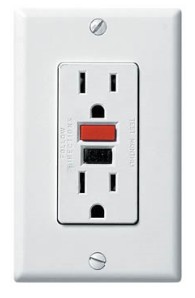
Ground Fault Circuit Interrupt Devices (GFCI)

Today’s post is about Ground Fault Circuit Interrupt Devices (GFCI). Most of you know what these look like, but here’s a little more information about what they are and how to use them.
By definition, a ground fault interrupter is a highly sensitive safety device installed in areas of your home where shock potential is highest. GFCI electric outlets prevent electrical shock, and are installed in kitchens, bathrooms, garages, and exterior areas where water may be present. GFCI receptacles are sensitive to power surges and interrupt power under certain conditions to prevent injury. These are special circuit breakers that are designed to break the flow of electricity in the event of a short circuit. This will prevent dangerous electrical shock. When this occurs, the GFCI outlets will need to be reset according to the manufacturer’s instructions.

GFCI outlets are often wired in a series. For example, the bathroom GFCI outlet controls the bathroom, and may possibly control other outlets throughout the interior and exterior as well as the garage.

If there is no power in a bathroom, kitchen, garage, or outside receptacle, these receptacles may be connected to a Ground Fault Circuit Interrupt (GFCI) device designed to interrupt the flow of electricity preventing electrical injury or damage. Locate the nearest GFCI outlet. Also Check the GFCI in the bathroom. Also be aware that some homes have multiple GFCI circuits, so be certain to inspect and reset the affected outlet. If the reset button has tripped, press it in to restore power. If that does not work, check and reset the circuit breaker in the panel box first, then press the GFCI reset button. If the outlet still fails, it may indicate a short in the appliance being used. If power is not restored, determine of the circuit is being overloaded. Two hair dryers of other appliances being used on one circuit could cause a breaker to trip. If other appliances will not operate, an electrician should be contacted.

IMPORTANT NOTE: Unattended appliances such as freezers, refrigerators etc. cannot be used on GFCI circuits. Do not plug appliances such as power tools, air conditioners, freezers, or refrigerators into GFCI outlets. The electrical surge that occurs when these appliances cycle will trip the GFCI outlets and break the circuit. These devices need to be plugged into a dedicated outlet.

To test GFCI circuits, press the Test button on the receptacle. The outlet should not perform. To reset, press the Reset button.

We hope this helps you feel a little more informed about GFCI’s!

Posted in Uncategorized

Garbage Disposals – What to do and NOT to do!

Garbage disposals seem pretty simple, right? Believe it or not, there are some things you need to be aware of when it comes to garbage disposals!

First, Do not load the disposal with food items before turning it on. For proper operation, turn on the cold water and start the disposal. Then, drop the food items slowly into the unit.

When the unit sounds clear, turn the disposal off and leave the water running for several seconds. This allows the food waste to be carried into your sewer lines.

Only foods that are not fibrous and easily pulverized should be placed into the disposal. Examples of foods not to place in the disposal are cornhusks, celery, onionskins, potato peels, olive pits, bones and solid or liquid grease. These items may cause your unit to overload or jam. If this happens, follow these corrective measures.

  • Turn off the disposal and the cold water.
  • Wait three minutes for the unit to cool, and then reset the button usually located on the bottom of the disposal.
  • If this does not correct the problem, your unit is probably obstructed. Follow these steps for proper removal.
  • Unplug the disposal before attempting a repair yourself.
  • Check the circuit breakers. An overload of this type may have tripped the circuit. Reset any tripped circuit breakers.
  • If your disposal has a service wrench, insert one end of the wrench into the bottom of the unit. Work back and forth until the disposal turns freely. If your disposal does not have a service wrench, insert a broom handle or mop handle into the throat of the unit and rotate the impeller back and forth. The obstruction will be loosened up so that it can be removed.
  • Remove the obstruction, plug the disposal in, press the reset button and proceed with the above steps for proper use.

We hope you find this information useful and helpful. Now carry on in the kitchen with confidence!

Posted in Uncategorized

Foreclosure Cost Calculator

The true cost of a foreclosure home may give you sticker shock. If the initial price of a foreclosure home looks attractive, dig a little further and you may be surprised at what you find! Do the math on our Foreclosure Cost Calculator before you commit to your next home! Click on the image below to get started.

Posted in Uncategorized